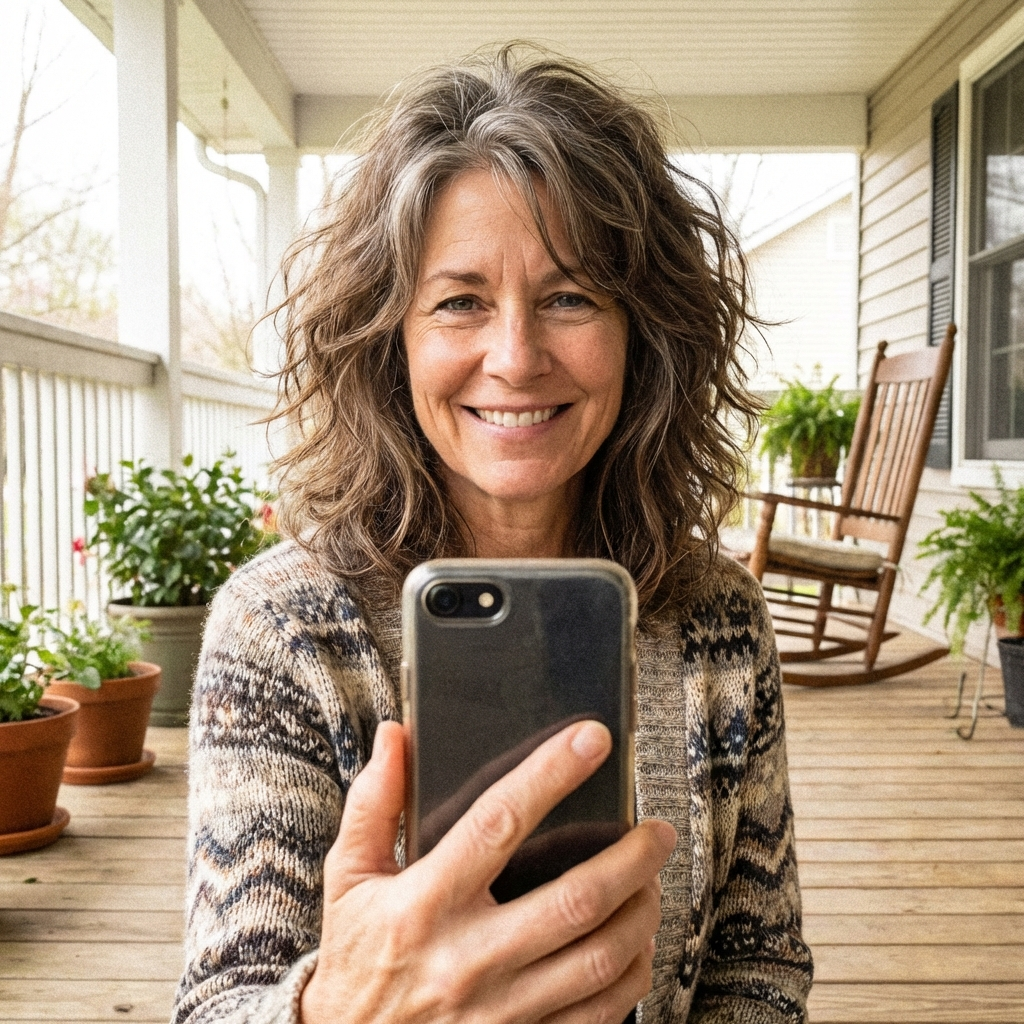
The Night I Found Him Standing in the Kitchen at 3AM — Eyes Open, Not Really There
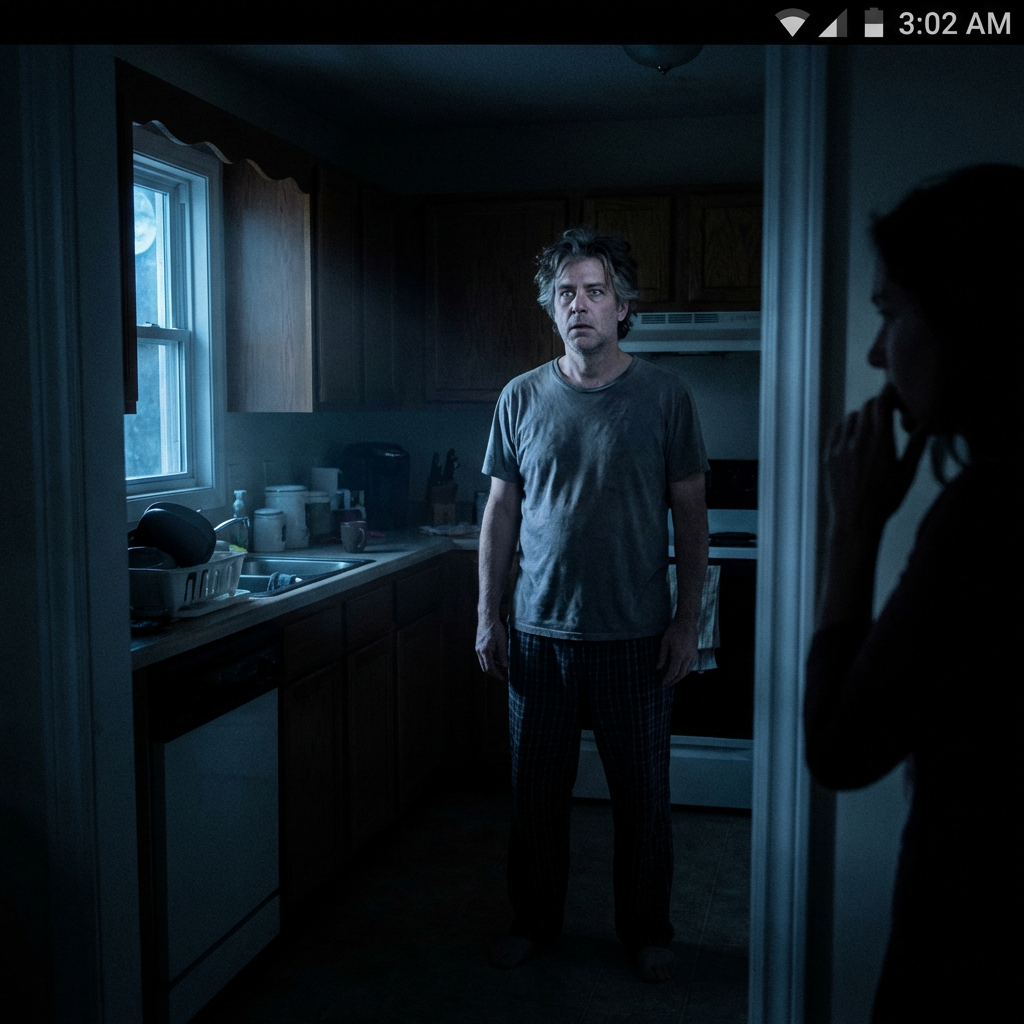
3:07 AM. The kitchen light was on. Fletcher was standing at the island — eyes open, not blinking, not moving. I knew something was wrong before I said his name.
I woke up the way I always do now — at exactly 3:07 AM, heart pounding, sheets damp, brain already racing before my eyes were fully open. But this time, Fletcher's side of the bed was empty. And the kitchen light was on.
I pulled on my robe and walked down the hallway of our Charlotte home. Thirty-one years we've lived in this house. Raised two kids here. I know every creak in the floor, every shadow on the wall at every hour. I know this house the way I know my husband's breathing patterns. And something — I couldn't name it yet — felt deeply, fundamentally wrong.
He was standing at the kitchen island. Just standing there. Both hands flat on the granite, head slightly forward, eyes wide open. Not blinking. The overhead light was on. A glass of water sat untouched in front of him. His lips were moving — barely — like he was trying to say something, or trying to remember how.
"Fletcher?"
Nothing. Not a flinch.
"Fletcher, honey. Look at me."
His eyes were open but he wasn't seeing me. He was looking through me the way you look through a window — focused on something miles away, or maybe nothing at all. I touched his arm and it was ice cold. In June. In North Carolina. I grabbed his shoulder and shook him gently, then harder, and his head finally turned toward me, slowly, like a camera panning. He blinked once. Twice. His mouth opened.
"Maggie? What — why are you —"
Then his knees buckled.
Two hundred and eleven pounds of retired operations consultant collapsed against our kitchen island, slid sideways, and hit the tile floor before I could catch him. The glass of water shattered. I was screaming his name and dialing 911 with wet, shaking hands. Our son Tyler — who'd been staying with us for the weekend — came running down the stairs in his boxers. He found his father on the kitchen floor and his mother on her knees next to him, pressing two fingers against Fletcher's neck to feel for a pulse.
There was a pulse. Weak. Fast. Too fast.
The paramedics arrived in eleven minutes. It felt like eleven hours.
They ran an EKG. Normal. CT scan of his head. Normal. Chest X-ray. Normal. The ER doctor — a woman who looked young enough to be our daughter Hannah's roommate — came back with a clipboard and a look on her face that I've seen enough medical dramas to recognize. The look that says: We found something. You're not going to like it.
"Mr. Haines, your heart is fine. Your brain scan is clear. There's no stroke, no seizure, no cardiac event."
Fletcher exhaled. I squeezed his hand.
"But your blood work is telling us a different story."
She paused. Looked at me, then back at him.
"Your liver enzymes are severely elevated. We're seeing markers we typically associate with significant hepatic stress — the kind that can cause confusion, disorientation, balance problems, and yes — episodes exactly like what your wife described tonight."
Fletcher's ER Blood Work — Atrium Health, Charlotte NC:
• ALT: 247 (Normal: 7-56 U/L) — over 4x normal
• GGT: 312 (Normal: 9-48 U/L) — nearly 7x normal
• Bilirubin: 4.1 (Normal: 0.1-1.2 mg/dL)
• Albumin: 3.0 (Normal: 3.5-5.0 g/dL)
• Liver function: Estimated 38% compromised
The ER doctor's exact words: "Mr. Haines, your liver is in serious distress. The episode tonight — the confusion, the unresponsiveness, the collapse — that's called hepatic encephalopathy. It happens when the liver can't filter toxins properly and they reach the brain. How much alcohol would you say you consume in a typical week?"
Fletcher looked at me. Then back at her. His face was the face of a man who genuinely didn't understand the question.
"A couple of bourbons after dinner. Maybe three on a weekend. I'm not — I'm not a heavy drinker."
The doctor nodded. Not surprised. Not judgmental. Almost sad.
"Mr. Haines, that's exactly the drinking pattern we see in most of the cases like yours. Two to three drinks a day, consistently, over decades. The liver handles it fine at first. Then one day it can't. And it doesn't warn you. It doesn't hurt. It doesn't give you a signal until it's already significantly compromised. Tonight was your signal."
I sat in that plastic ER chair and felt the world rearrange itself. Fletcher. My Fletcher. The man who coached Tyler's little league team. The man who walks the dog at 6 AM. The man who grills on Sundays and always has a bourbon in his hand while he does it — the same way his father did, and his father before him. That bourbon. Two a night. For twenty-five years. Not binge drinking. Not blackouts. Not stumbling or slurring. Just a quiet, consistent, completely normal habit that had been silently, invisibly destroying his liver for a quarter century.
And I hadn't seen it coming. Or — and this is the part that still keeps me awake at night — maybe I had.
The Warning Signs I Watched for Three Years — And Told Myself Were "Just Age"
Sitting in that ER room, watching Fletcher sleep with an IV in his arm and monitors on his chest, I pulled out my phone and opened the Notes app. I started writing down every strange thing I'd noticed about my husband over the past three years. Not because a doctor asked me to. Because I suddenly realized I'd been keeping a mental list without admitting it to myself.
The 3 AM wake-ups started three years ago.
I know because I remember the first time. It was a Tuesday in October. I woke up at 3:14 AM — not to an alarm, not to a noise. Just awake. Heart racing. I turned over and Fletcher was lying on his back, eyes open, staring at the ceiling. Wide awake. I asked him what was wrong. He said: "Nothing. Just woke up. Go back to sleep."
It happened again the next night. And the next. Within a month, both of us were waking up between 3 and 4 AM almost every single night. Sometimes he'd get up and pace the house. Sometimes I'd find him on the couch watching TV on mute. Sometimes we'd both just lie there, staring at the ceiling in the dark, exhausted but wired. Two people who used to sleep like the dead, suddenly broken at the same hour every night.
We blamed it on age. Fletcher was 54 then. I was 52. "This is just what happens," we told each other. "Your sleep gets worse when you get older. Everybody says so."
But it wasn't just the sleep.
What I noticed about Fletcher — the list I wrote at 4 AM in his ER room:
• 3 AM wake-ups — every single night for three years. Not insomnia. He'd fall asleep fine. Then bolt awake at 3 AM like an alarm went off inside him.
• Brain fog — forgetting words mid-sentence. Calling Tyler by the wrong name. Losing his train of thought during conversations. A man who used to manage $40M operations budgets couldn't remember where he put his keys.
• The exhaustion — bone-deep tired by 2 PM every day. He used to refinish furniture in the garage on weekends. Now he falls asleep in his recliner by noon.
• The belly — 30 pounds in three years. Not from eating more. From something metabolic, something inside that changed.
• The irritability — short fuse. Snapping at me over nothing. Road rage that scared me. A man who was patient with toddlers now losing his temper with the cable company.
• The skin — grey. Dull. Dark circles that never went away. He looked 65, not 57.
• The smell — not alcohol. Something chemical. Metallic. On his breath in the morning and on his pillow. I Googled it once and closed the tab because the results scared me.
I showed the list to the ER doctor. She read it slowly, nodded at each item, and said:
I thought about all the things we'd tried to fix the sleep. The melatonin. The weighted blanket. The $400 mattress topper from that Instagram ad. The "sleep hygiene" routine — no screens after 9, chamomile tea, the whole ritual. Nothing worked. Nothing worked because we were treating a symptom and ignoring the organ that was causing it.
Then the doctor said something that turned my blood cold.
"Mrs. Haines — given that you've also been waking at 3 AM for the past three years, and given that you mentioned you also have wine with dinner most evenings — I'd like to run your blood work too."
I almost said no. I almost said "This isn't about me. I'm here for Fletcher." But something in her eyes — the same thing I'd been ignoring in the mirror for three years — made me roll up my sleeve.
Then They Tested Me
The results came back in forty-five minutes. I was sitting in Fletcher's room eating a vending machine granola bar and pretending I wasn't terrified.
My Blood Work — Maggie Haines, Atrium Health ER:
• ALT: 138 (Normal for women: under 33) — over 4x normal
• GGT: 187 (Normal: 9-48) — nearly 4x normal
• Bilirubin: 2.8 (Normal: 0.1-1.2)
• Liver function: Estimated 29% compromised
The doctor: "Mrs. Haines, your numbers are worse than your husband's relative to what's normal for women. Women develop liver damage at lower levels of drinking and at faster rates than men. Less body water. Fewer metabolizing enzymes. More vulnerability to inflammation. Your one glass of wine a night has done proportionally more damage to your liver than his two bourbons have done to his."
I looked at Fletcher. He looked at me. We'd been sitting in that ER room worrying about him, and it turned out we were both falling apart. The same quiet routine — dinner, drinks, bed, 3 AM wake-up, exhaustion, repeat — had been silently destroying both of us. Same pattern. Same poison. Same silence from the organ that was supposed to protect us.
Fletcher reached over and took my hand. His voice was hoarse from the IV fluids and the humiliation of collapsing in his own kitchen in front of his son.
"We're going to fix this, Maggie. Both of us. Whatever it takes."
⬇ What the ER doctor never told us — and what our family doctor never tested for ⬇
We Spent $1,047 Trying to Fix It — Nothing Worked
The ER discharged us at 6 AM with a referral to a hepatologist and a pamphlet about "liver-healthy lifestyle choices." The pamphlet was three pages. One said "reduce alcohol intake." One said "eat more vegetables." One said "exercise regularly." It was the medical equivalent of telling a drowning man to swim.
Fletcher and I spent the next four months — June through September — throwing money and hope at anything that promised to help. Every morning we'd wake up at 3 AM, stare at the ceiling, and wonder if today was the day something would finally work.
❌ Attempt #1: Milk Thistle supplements — $34/month × 3 months = $102
Every "liver health" Google search points here. We both took 1,000mg daily. Fletcher's energy improved slightly for two weeks, then flatlined. My 3 AM wake-ups continued without a single night's relief. After three months, Fletcher got follow-up blood work: ALT had dropped from 247 to 219. The hepatologist said: "Marginal. Not clinically meaningful." The brain fog, the exhaustion, the irritability — all unchanged.
❌ Attempt #2: NAC (N-Acetyl Cysteine) — $28/month × 2 months = $56
A Reddit thread said NAC was "the liver's best friend." Fletcher took 1,200mg daily. His skin looked slightly better. But the 3 AM wake-ups were still there. Every single night. Like clockwork. Like something inside him was running a broken alarm that no single ingredient could silence.
❌ Attempt #3: "Liver Detox" juice cleanse — $189 for a 7-day program
A wellness influencer on Instagram promised it would "reset your liver in one week." Fletcher lasted four days. He was irritable, hungry, exhausted, and — this is the part that broke my heart — he still woke up at 3 AM every night of the cleanse. On day five he ate a cheeseburger in the driveway and told me he was done. I couldn't blame him.
❌ Attempt #4: B-vitamin complex + individual supplements — $47/month × 3 months = $141
Our family doctor suggested B-complex for the fatigue and brain fog. We added B1, B12, folate. Fletcher's energy improved — maybe 20%. But the sleep was still broken. The belly weight was still there. The irritability was still there. And my numbers hadn't budged at all.
❌ Attempt #5: Sleep specialist + prescription sleep aid — $350 (consultation) + $209 (medication)
The sleep specialist did a full workup. No sleep apnea. No restless leg syndrome. She prescribed Trazodone. Fletcher took it for six weeks. He'd fall asleep at 10 PM and still wake up at 3 AM — except now he was groggy AND awake. The worst of both worlds. I tried it too. Same result. We were medicating a symptom of liver failure with a sleep drug. Like putting a band-aid on a broken bone.
Total spent: $1,047
Total improvement: Negligible
3 AM wake-ups: Still happening every single night — for both of us
Fletcher's liver enzymes: Still dangerously elevated
My liver enzymes: Unchanged
The problem wasn't effort. The problem was that every solution addressed one pathway while the other six kept failing.
The 2 AM Research Session That Changed Everything
It was a Tuesday night in October. Fletcher was asleep — for now. I was sitting at the kitchen table at 2:47 AM with my laptop, three tabs of PubMed open, and the kind of desperate energy that only comes from watching someone you love deteriorate in front of you while every expert shrugs.
I'd been reading about acetaldehyde — the toxic byproduct your liver creates when it processes alcohol. Not alcohol itself. The thing alcohol becomes inside you. And what I found made me put my coffee down and stare at the screen for a full minute.
The Acetaldehyde Problem — What Nobody Tells You:
When you drink, your liver converts alcohol into acetaldehyde — a compound that is 30 times more toxic than alcohol itself. It's classified as a Group 1 carcinogen by the WHO. In healthy, young livers, acetaldehyde gets quickly converted to harmless acetate. But after years of consistent drinking — even moderate amounts — your liver's ability to clear acetaldehyde slows dramatically.
The result: acetaldehyde accumulates. It damages DNA. It triggers chronic inflammation. It depletes glutathione (your body's master antioxidant). It disrupts sleep cycles. It causes brain fog, fatigue, irritability, and mood disruption. And it does all of this silently, for years, before any symptom is severe enough to send you to the ER.
— World Health Organization IARC Monographs; Journal of Hepatology, 2020
Then I found the study that cracked it open.
A 2012 paper in The Journal of Neuroscience on a compound called DHM — Dihydromyricetin. Researchers at UCLA found that DHM enhanced the liver's ALDH enzyme activity by up to 244% — dramatically accelerating the breakdown of acetaldehyde. But here was the key insight: DHM alone wasn't enough. The researchers noted that maximum liver recovery required simultaneous support across multiple pathways — glutathione restoration (NAC), liver cell repair (Milk Thistle), and B-vitamin replenishment (especially Thiamine, which alcohol depletes aggressively).
Single ingredients fail because they address one pathway while the other pathways continue to deteriorate. It's like fixing one leak in a boat that has seven holes. The boat still sinks.
Why the 3 AM wake-ups wouldn't stop:
The liver's peak detoxification cycle runs between 1-3 AM. When acetaldehyde and other toxins accumulate faster than the liver can process them, the organ triggers a cortisol spike to mobilize emergency resources. That cortisol spike jolts you awake — heart pounding, mind racing, unable to fall back asleep. It's not insomnia. It's not anxiety. It's your liver calling for backup at 3 AM because it's drowning.
Melatonin can't fix it. Sleep hygiene can't fix it. Trazodone can't fix it. The only thing that stops the 3 AM wake-up is reducing the toxic load on the liver so it can complete its cycle without emergency measures.
— Hepatology International, 2019; Chronobiology International, 2021
I spent three more hours reading. I made a spreadsheet — Fletcher's an operations guy, I've absorbed some of his habits — mapping every failed solution against the pathways it did and didn't address. The pattern was devastating in its clarity:
Every pathway feeds the next. You can't fix one without fixing all of them. That's why $1,047 worth of individual supplements didn't move the needle.
The Formula That Targets Every Pathway at Once
Fletcher's hepatologist — Dr. Marcus Chen at Carolinas Liver Center — was the one who finally connected the dots. At our third follow-up appointment, after seeing that four months of individual supplements had barely moved Fletcher's numbers, he pulled out a piece of paper and drew a diagram of the liver's detoxification pathways.
"Mr. and Mrs. Haines — you've been doing everything right, just one piece at a time. The liver doesn't recover one pathway at a time. It recovers all at once, or not at all. You need DHM for acetaldehyde clearance, NAC for glutathione restoration, Milk Thistle for liver cell repair, and Thiamine plus B-complex for the neurological and metabolic damage. All together. At therapeutic doses. Every day."
He told us about a formula called Cloud9 Daily Restore. Not something from Instagram. Not something from a wellness influencer. A formula he'd started recommending to his moderate-drinking patients because it was the only product he'd found that combined all five critical compounds at clinical doses in a single supplement.
What's Inside Cloud9 Daily Restore — And Why Each Ingredient Matters
The Multi-Pathway Approach — All Addressed Simultaneously:
- Acetaldehyde Clearance → DHM (300mg)
- Glutathione Restoration → NAC (600mg)
- Liver Cell Repair → Milk Thistle (250mg, 80% Silymarin)
- B-Vitamin Replenishment → Thiamine (100mg) + Full B-Complex
- 3 AM Wake-up Cycle → DHM + NAC + Milk Thistle (reduce toxic load so liver completes its detox cycle without the cortisol spike)
— Dr. Marcus Chen, Carolinas Liver Center, Charlotte NC
90-Day Money-Back Guarantee · Free Shipping · No Subscription Required
What Happened to Both of Us — Week by Week
We started Cloud9 Daily Restore on a Monday morning in late October. Both of us. Same dose, same time, every day with breakfast. Fletcher took one before his evening bourbon too. I took one before my glass of wine. Dr. Chen said to give it eight weeks before expecting blood work changes — but to pay attention to how we felt.
I kept a journal. Because after $1,047 in failed solutions, I needed proof that something was either working or wasn't.
📅 Week 1 — The First Night It Didn't Happen
Day four. I woke up and looked at my phone. 5:42 AM. I stared at the number. Then I looked at Fletcher. He was still asleep. Breathing deeply. Mouth slightly open the way it does when he's truly out. I lay there for ten minutes, afraid to move, afraid that acknowledging it would break the spell. We had both slept through the night for the first time in three years. It happened again on day five. And day six. By the end of the first week, the 3 AM wake-ups had gone from every night to twice. Fletcher said he felt like he'd been "unplugged from a wall socket" — that background hum of tension he didn't even know he was carrying had gone quiet.
📅 Week 2 — The Fog Starts Lifting
Fletcher was reading the newspaper at breakfast — actually reading it, not staring at it. He looked up and said: "Maggie, I just read three articles and I remember all of them. When's the last time that happened?" I didn't have an answer because I couldn't remember either. The brain fog — that thick, cotton-wrapped feeling that made every thought feel like it was moving through mud — was thinning. For both of us. I caught myself doing mental math at the grocery store instead of pulling out my phone. The 3 AM wake-ups dropped to once a week, then stopped entirely by day 14.
📅 Week 3 — The Energy Shift
Fletcher was in the garage on a Saturday morning. I heard the table saw running at 8 AM and nearly dropped my coffee. He was refinishing an old dresser he'd bought at an estate sale six months ago and hadn't touched. He worked for four hours straight. No nap at noon. No collapse into the recliner. He came inside for lunch, sweaty and grinning, and said: "I forgot what it feels like to have a body that actually works." My energy was up too — I'd been dreading a garden project for months and knocked it out in one afternoon. The 2 PM crash was gone. For both of us.
📅 Week 4 — Other People Start Noticing
Tyler called on a Sunday. Fletcher talked to him for forty-five minutes — animated, laughing, telling stories. When he hung up, he said Tyler had asked: "Dad, are you on something? You sound like yourself again." Our neighbor Bill commented that Fletcher looked "ten years younger." My sister said I looked "rested for the first time in years." The irritability — Fletcher's short fuse that had been straining our marriage for three years — was gone. He was patient again. Present. The man I married was coming back.
📅 Week 6 — The Belly, the Skin, the Everything
Fletcher had lost 11 pounds without changing his diet. The bloated, distended belly that had made him look pregnant was flattening. His skin had color again — warm, healthy, alive instead of that grey pallor that made him look like a man made of concrete. The dark circles under his eyes faded. My skin was glowing too — my aesthetician asked what I'd changed. The metallic smell on Fletcher's breath and pillow? Gone. Completely gone. I hadn't realized how much it had been bothering me until it disappeared.
📅 Week 8 — The Blood Draw
We drove to Carolinas Liver Center together. Both of us. Same lab. Same blood draw. Same wait. Dr. Chen came back into the room with our results and did something I've never seen a doctor do: he smiled first.
The Numbers Don't Lie
Fletcher's Lab Results — Before vs. After Cloud9 Daily Restore (8 Weeks):
❌ BEFORE (ER Night)
- ALT: 247
- GGT: 312
- Bilirubin: 4.1
- Albumin: 3.0
- Liver function: 38% compromised
- 3 AM wake-ups: Every night
✅ AFTER (8 Weeks)
- ALT: 38
- GGT: 44
- Bilirubin: 0.9
- Albumin: 4.2
- Liver function: 94% restored
- 3 AM wake-ups: None
Maggie's Lab Results — Before vs. After Cloud9 Daily Restore (8 Weeks):
❌ BEFORE
- ALT: 138
- GGT: 187
- Bilirubin: 2.8
- Liver function: 29% compromised
- 3 AM wake-ups: Every night
✅ AFTER (8 Weeks)
- ALT: 27
- GGT: 36
- Bilirubin: 0.7
- Liver function: 96% restored
- 3 AM wake-ups: None
Dr. Chen sat back and shook his head slowly.
— Dr. Marcus Chen, Hepatologist
Beyond the lab numbers — what actually changed in our lives:
✓ 3 AM wake-ups → Gone. Both of us. Sleeping 7+ hours straight.
✓ Brain fog → Completely cleared. Fletcher's doing crossword puzzles again.
✓ Energy → Steady all day. No crashes. No afternoon naps.
✓ Fletcher's weight → Down 14 pounds in 8 weeks without dieting.
✓ Irritability → Gone. Our marriage feels like it did ten years ago.
✓ Skin & appearance → Both of us look years younger. Multiple people have commented.
✓ The metallic smell → Gone. His pillow smells like his pillow again.
✓ Evening drinks → Still enjoying them. Without the silent damage.
Cloud9 Daily Restore

DHM 300mg · NAC 600mg · Milk Thistle 250mg (80% Silymarin) · Thiamine 100mg · Full B-Complex
The only formula that targets acetaldehyde clearance, glutathione restoration, liver cell repair, and B-vitamin replenishment simultaneously — at clinical doses proven in peer-reviewed research.
If your numbers don't improve, full refund. Even on empty bottles.
What Other Couples Are Experiencing
Six Months Later — The Life We Got Back
I'm writing this from our screened-in porch in Charlotte. It's a Sunday afternoon. Fletcher is in the garage refinishing a mid-century credenza he found at an estate sale — his fourth project this year. The table saw has been running since 9 AM. He'll come in for lunch, sweaty and grinning, the way he used to before the years took that away from us.
Last month we drove to Asheville for our anniversary — 31 years. We hiked the Blue Ridge Parkway. Fletcher led the way. No stops, no panting, no "I need to sit down" breaks. At the summit he turned around and said: "Maggie, I feel like I'm 45 again." That night we had dinner at a nice restaurant. He had a bourbon. I had a Pinot Noir. We clinked glasses and neither of us felt a shred of guilt — because we knew we were protected.
The 3 AM wake-ups are a memory now. We sleep through the night, every night. Both of us. Seven hours, sometimes eight. I wake up rested. Clear. Calm. No racing heart, no dread, no staring at the ceiling counting the hours until the alarm goes off.
Tyler called last week and said: "Mom, Dad sounds like himself again. I was worried for a while. I didn't want to say anything, but — I was worried." Hannah flew in from Denver and the first thing she said was: "You both look amazing. What are you doing?"
What we're doing is simple. We're taking two capsules a day. We're living our life. And we're no longer letting a silent organ fail in secret while we blame everything on age.
If you or your partner experience ANY of these — your liver may be sending signals right now:
☐ Waking up between 2-4 AM — consistently, for weeks or months
☐ Brain fog, memory problems, losing words mid-sentence
☐ Bone-deep fatigue that sleep doesn't fix
☐ Unexplained weight gain — especially the belly
☐ Irritability, short fuse, mood swings
☐ Dull, grey, aged-looking skin
☐ Dark circles that never go away
☐ Metallic or chemical smell on breath or pillow
☐ Needing a drink to "wind down" at night
☐ Anxiety or dread upon waking
If 3 or more sound familiar — especially the 3 AM wake-ups — please don't do what we did and spend $1,047 and four months discovering that single ingredients can't fix a multi-pathway problem.
What You'd Pay Buying Each Ingredient Separately
Acetaldehyde clearance + GABA protection
Glutathione restoration + detoxification
Liver cell repair + protection
Nerve function + energy metabolism
Neurotransmitters + energy + cellular repair
90-Day Money-Back Guarantee. Try it completely risk-free. If you don't feel a noticeable difference in your sleep, energy, and clarity — or if your next blood work doesn't improve — you get every penny back. No questions asked. Even on empty bottles. Fletcher and I noticed changes in the first week. Most couples do.
Every night you wait is another 3 AM wake-up. Another day of fog. Another cycle of your liver falling further behind. Another morning where you look in the mirror and see someone older than you should be.
Fletcher collapsed in our kitchen at 3 AM. That was our wake-up call — literally. Tyler found his father on the floor. I found out my own liver was failing. We spent $1,047 learning that single ingredients can't fix a multi-pathway problem. You don't have to learn it the hard way.
You're reading this page right now. This is your wake-up call. Don't wait for the 3 AM one.
Start Sleeping Through the Night Again — Risk-Free →Join thousands of couples who stopped waking up at 3 AM and started protecting themselves.
DISCLAIMER: This article represents the personal experience of Margaret and Fletcher Haines and is provided for informational purposes only. Individual results may vary. The statements made regarding Cloud9 Daily Restore have not been evaluated by the Food and Drug Administration. This product is not intended to diagnose, treat, cure, or prevent any disease. Always consult your physician before starting any new supplement regimen. The testimonials and results described represent individual experiences and may not be typical. The symptom information provided is for educational purposes and should not be used as a substitute for professional medical advice. If you are experiencing any of the symptoms described, please consult a qualified healthcare professional. This website is not part of the Facebook website or Facebook Inc. FACEBOOK is a trademark of FACEBOOK, Inc. © 2026 Margaret Haines. All rights reserved.